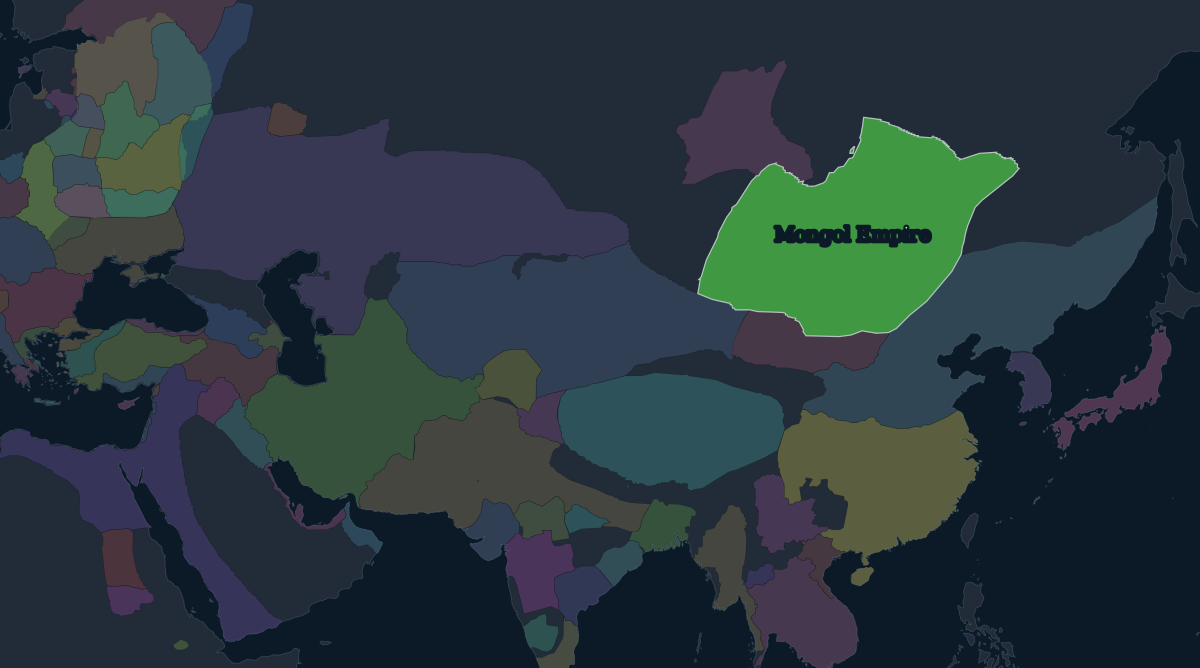
1206: Genghis Khan
In 1206 an assembly of the steppe peoples, a kurultai, held by the Onon River, proclaimed TemüjinGenghis Khan. He had spent two decades defeating or absorbing the rival Mongol and Turkic confederations of the eastern steppe: the Tatars, the Keraites and the Naimans. The state he created was organised for war. Its army was divided into units of ten, a hundred and a thousand, deliberately mixing the old tribes.
Around it lay the states the Mongols would conquer: the Western Xia and the Jurchen Jin dynasty in northern China, the Kara-Khitan Khanate in Central Asia, and beyond it the Khwarazmian Empire.
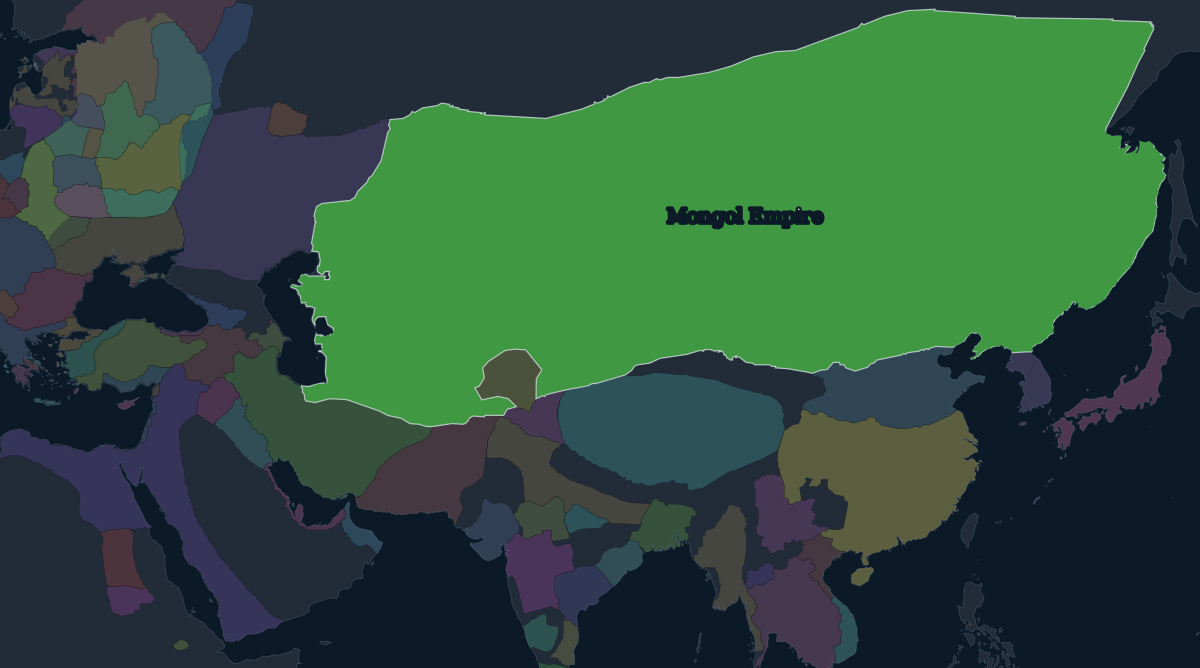
1227: from China to the Caspian
The campaigns that followed were fast and very destructive. The Mongols attacked the Western Xia from 1209 and the Jin from 1211, taking the Jin capital Zhongdu, modern Beijing, in 1215. In 1218 they absorbed the Kara-Khitan lands. When a Mongol trade caravan was massacred at the Khwarazmian border town of Otrar and an envoy sent to protest was killed, Genghis invaded. Between 1219 and 1221 the great cities of Transoxiana and Khorasan, among them Bukhara, Samarkand, Merv and Nishapur, were taken, and many of their people were killed.
Genghis Khan died in 1227 while campaigning against the Western Xia, who were destroyed that same year.
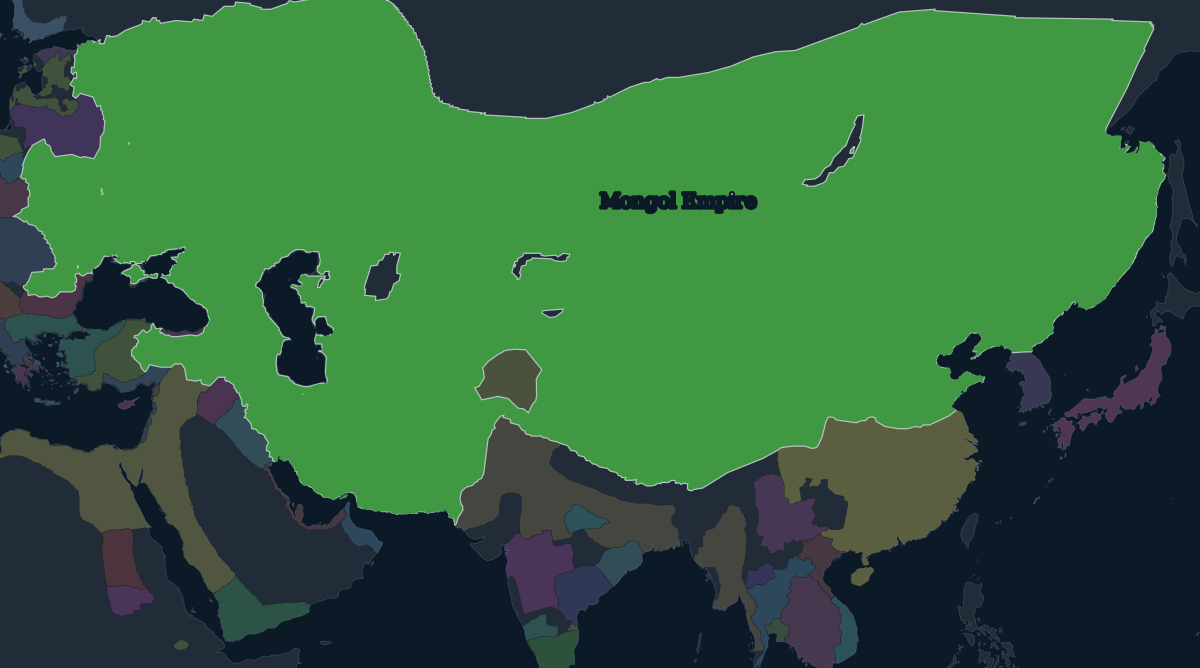
1259: the largest land empire in history
Under his son Ögedei the Mongols finished off the Jin in 1234. A great western campaign from 1236 conquered Volga Bulgaria and the principalities of Rus', sacking Kiev in 1240. In 1241 it defeated the Polish and Hungarian armies at Legnica and Mohi, then withdrew after news arrived of Ögedei's death.
Under Möngke, Hülegü led an army into the Middle East. In 1258 it sacked Baghdad and killed the last Abbasid caliph, ending a caliphate that had lasted five centuries. When Möngke died in 1259 the empire stretched from Korea and the Pacific to Anatolia and Ukraine.
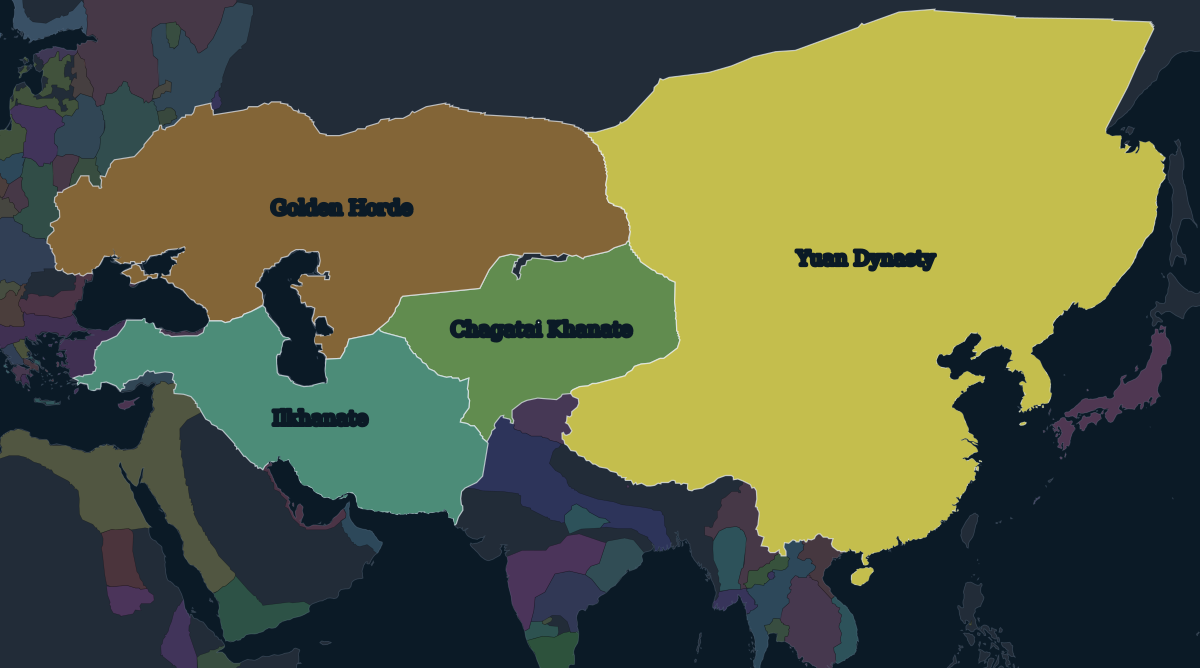
1300: four khanates
Möngke's death set off a succession war between his brothers Kublai and Ariq Böke (1260–1264). In 1260 the Mamluks of Egypt defeated a Mongol army at Ain Jalut, which stopped the advance into the Mediterranean world. From then on the empire was four states in practice, each ruled by a branch of Genghis Khan's family:
The Golden Horde on the western steppe and over the Rus' principalities; theChagatai Khanate in Central Asia; the Ilkhanate in Persia and Iraq; and theYuan dynasty, which Kublai proclaimed in 1271 and which completed the conquest of Song China in 1279. The map keeps a single Mongol Empire until Kublai's death in 1294, the date its source uses, but the khanates had been acting independently for a generation by then.
None of them lasted. The Ilkhanate broke up after 1335, the Ming drove the Yuan out of China in 1368, and the Golden Horde splintered into successor khanates during the fifteenth century.